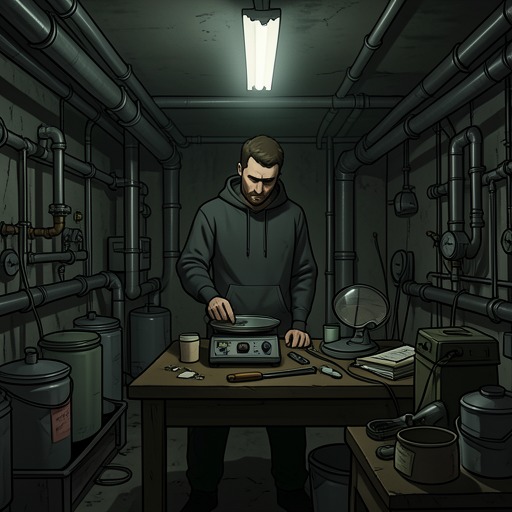
Weed Shack
The Short and Tragic Life of Robert PeaceThe Weed Shack is a two-story clapboard house on Temple Street, two blocks west of Yale’s campus proper. Leaseholder Sherman Feerick, a junior from Montclair and former football star, lived there with four or five others. For Rob Peace, the house became more than a place to smoke: it was a social refuge, a Newark-linked community, and the setting in which his movement between Yale achievement and illegal drug dealing became organized.
Setting and Community
The house stood close enough to Yale to remain within the university’s orbit but outside its formal spaces. Its residents and regulars occupied a living room furnished with sunken couches and scavenged chairs, where a bong or joint was almost always lit and students gathered to get high and speak with unusual frankness about Yale, Yalies, and what the narrative calls the Yale Experience. The physical informality of the house contrasted with the ordered world of Yale’s colleges, regulations, laboratories, athletic schedules, and status distinctions.
Sherman recognized Rob immediately as someone marked by the same regional background. When they first met, Sherman referred to him as the new token poor African American male Newarker admitted to Yale each year. Their shared knowledge of Newark, despite both men living outside it while at Yale, created an immediate bond. The Weed Shack thus functioned as a place where Rob did not have to explain the particular social world from which he came, even as the house’s conversations sometimes reduced Yale’s complexities to a shared indictment.
Criticism of Yale
The Weed Shack’s residents treated the living room as a safe haven for arguments about the university. Their complaints ranged from familiar accusations that Yale favored rich students, legacies, and phonies to more specific objections about financial aid, social hierarchy, and teaching. They claimed that aid packages served public relations while generating excessive paperwork, that Yale’s social structure was more vapid than high school, and that professors often left undergraduates to teaching assistants while concentrating on research.
Their criticism also addressed the university’s racial organization. Sherman pointed to the minority orientation program’s seminars on note-taking as patronizing, described the Af-Am House as smaller and more remote than other cultural centers, and objected that Yale would not officially sponsor Af-Am Week, the annual gathering of Black students from across New England. The group concluded that the university was racist. The Weed Shack therefore offered a counter-discourse to Yale’s prestige: the men knew that a Yale education was rare and valuable, but intoxication, resentment, and shared grievance made it easier to lose sight of that larger opportunity.
Rob’s Drug Network
Rob entered the Weed Shack’s drug economy through Sherman. After Julius “Flowy” Starkes raised the possibility of selling marijuana on campus, Rob discussed the idea with Sherman less to seek permission than out of respect for Sherman’s experience. Rob explained that Charles Cawley’s tuition checks went directly to Yale and did not cover books or laboratory equipment, while his mother was exhausted, poor, and alone. Sherman responded by directing a portion of his business toward Rob rather than treating Rob as a competitor, just as Rob had earlier helped Tavarus Hester in high school.
Sherman taught Rob how to avoid the university’s attention, which he regarded as nearly effortless so long as Rob was not careless. The Weed Shack consequently served as an informal training ground in concealment, distribution, and the management of two identities. Rob could remain a Yale student in official settings while using the house as a base for marijuana-related activity that was kept away from his room and hidden from his roommates.
The house also connected Rob to a larger supply chain. During Thanksgiving vacation, he planned to reunite with the Burger Boyz and meet Flowy’s supplier so that he could bring several ounces of marijuana back to Yale and sell it in eighth-ounce portions to classmates before final examinations. The Weed Shack was therefore not merely a place of consumption; it helped convert marijuana from a private habit into a recurring commercial practice.
A Counter-Campus and Transitional Space
The Weed Shack’s importance lies in its position between institutions and identities. Yale represented disciplined achievement, elite cultural capital, and a future supposedly opened by education. The Temple Street house represented off-campus friendship, marijuana, Newark affiliation, and a language of distrust toward the institution that had admitted Rob. Neither world simply erased the other. Rob continued to study and participate in university life while spending time with people connected to the Weed Shack and using its network to sell marijuana.
That overlap made the house a transitional space rather than a simple escape from Yale. It gave Rob companionship and a setting in which he could speak without performing the role of the exceptional Yale student, but it also normalized the activity that could place his degree in jeopardy. When Yale later confronted him about selling drugs, the formal regulations defined unlawful possession, use, purchase, or distribution as an offense punishable by expulsion. The contrast was stark: in the Weed Shack, marijuana dealing could appear practical and manageable; inside Yale’s disciplinary system, the same conduct became grounds for institutional removal.
The house thus embodies the instability of Rob’s social mobility. It offered access to a familiar community and a way to earn money for expenses that his scholarship arrangement did not cover, yet it also reinforced the separation between his public academic identity and his private economic life. Its couches, smoke, and conversations provided belonging, while its drug network deepened the compartmentalization that shaped his trajectory. In that sense, the Weed Shack was both refuge and launch point: a modest off-campus house from which Rob could criticize Yale, remain connected to Newark, and enter a market whose consequences eventually extended far beyond the living room.